
Showing posts with label Courses. Show all posts
Showing posts with label Courses. Show all posts
Thursday, July 23, 2026
Monday, July 20, 2026

Wednesday, April 8, 2026
Fall 2026 Courses in Art History
Courses for Undergraduate Students
ARTH 282
Introduction to World Art
Tu Th 11-12:15 pm, Face-to-Face (S. Bell)
Tu Th 12:30-1:45 pm, Face-to-Face (E. Stuart)
Tu Th 2-3:15 pm, Online Synchronous (M. Quinlan)
An introduction to the ways in which human civilization has imagined itself and expressed its vision of the world over time and in different cultural contexts across the globe, this course also considers how these arts continue to be interpreted by contemporary scholars and audiences. The course can serve as one of the required courses for School of Art and Design majors. This is an NIU General Education course in the Knowledge Domain: Creativity and Critical Analysis and Pathway: Origins and Influences.
ARTH 292
Introduction to Modern Arts and Design
M W 11-12:15 pm, Face-to-Face (R. Houze)
M W 12:30-1:45 pm, Face-to-Face (R. Houze)
This course is a wide-ranging survey of artworks and practices that have challenged the artistic status quo while responding to the diverse economic, political, and social contexts of the recent past and present. The course can serve as one of the required courses for School of Art and Design majors. This is an NIU General Education course in the Knowledge Domain: Creativity and Critical Analysis and Pathway: Creativity, Innovation and Change.
ARTH 310
Studies in Ancient and Middle-Eastern Art: Etruscan and Early Roman Art
Tu Th 2-3:15; Hybrid: Face-to-Face and Online Synchronous (S. Bell)
The Etruscans were a vibrant, independent people whose distinct civilization flourished in central Italy for most of the first millennium BCE and whose artistic, social and cultural traditions helped shape the ancient Mediterranean, European, and Classical worlds. This course surveys Etruscan art and culture, incorporating the most up-to-date research and recent archaeological discoveries. In addition to addressing traditional topics, such as architecture, wall painting, ceramics, and sculpture, this course will look at such issues as Etruscan jewelry as an expression of social identity, the important role of women in its society, the afterlife of their civilization, etc. The course is divided into three parts: (1) an historical introduction, in which we will survey the evidence, general trends and historical development of the Etruscans; (2) thematic topics, in which we will look in depth at particular aspects of their art, society and culture; and (3) a look at contemporary issues, including the debate over their origins and the impact of looting and the modern antiquities trade on their heritage.
ARTH 330F
Studies in Early Modern European Art: When South and North Met
Tu 6:00-8:40 pm, Online Synchronous (M. Quinlan)
Th 6-8:40 pm, Online Synchronous (M. Quinlan)
With a focus on fifteenth- and sixteenth-century European art, this course examines the common ground as well as the cultural differences that separated, and to some degree still separate Southern Europe and Northern Europe and their visual cultures. The histories of science, religions, and art will move through these centuries. This is a General Education Course. It is Writing Infused and includes undergraduate research. The course serves as an elective for the BFA, BA Art, BS Art, and B.S.Ed degree program
ARTH 350
Studies in Contemporary Art
M W 11-12:15 pm, Face-to-Face (S Evans)
M W 12:30-2 pm, Face-to-Face (S Evans)
Study of the history of contemporary art is a study of ideas about art as well as intertwined historical contexts. On the one hand, we see the increasing institutionalization and commodification of art. On the other hand, we see the pursuit of social justice. The era of contemporary art begins in the mid-1950s, when artists adopt Marcel Duchamp’s insight that art is primarily conceptual, not visual. This means that an artwork is not solely a visually stimulating object; instead, it is a vehicle for exploration. In addition to lectures and readings, and two brief essays, this course gives students the opportunity to present their favorite contemporary artist to the class. Every third class will be wholly devoted to discussion. ARTH 350C satisfies PLUS (Creativity and Critical Analysis) requirements, is included in the Creativity, Innovation and Change Pathway, and has been certified
as “Writing Infused.”
ARTH 361/ ENVS 361X
History of Sustainable Design
M W 9:30-10:45 am, Face-to-Face (R. Houze)
Beginning with the impulse to preserve the past in the late eighteenth and early nineteenth centuries, this course examines how designers have responded to shifts in industrialization and urbanization over the past two decades, with attention to new technologies and new attitudes towards community and social responsibility. The course will include lectures, readings, and discussions on thematic topics including historic preservation, sustainable technologies, the relationship of design to environment, collective housing policies, counterculture, new urbanism, and the Green movement. ARTH 361 satisfies PLUS (Society and Culture) requirements, is included in the Sustainability Pathway, and has been certified as “Writing Infused.” Environmental Studies majors should register for ENVS 361X.
ARTH 370G
Studies in Asian Art: Thematic Subjects—Ukiyo-e
W 6-8:40 pm; Hybrid: Face-to-Face and Online Synchronous during October (H. Nagata)
This course will focus on Ukiyo-e (multicolor woodblock prints), which developed during the Edo period from the 17th c. and continued through the 19th into the 20th c. The world of ukiyo-e or Japanese multicolor woodblock prints from the early modern period (Edo period, 17th-19th c.) is extremely rich in technical innovation, styles, subject-matter, and genres. There are also exquisite paintings on hanging scrolls, handscrolls, and folding screens in the ukiyo-e style. This course will ask you to gain a basic knowledge of ukiyo-e craft, artistry, and cultural contexts, as well as to gain fresh insight and a deeper understanding of the art form achieved through solid analytical and interpretive skills and original research. There will be an opportunity to collaborate on a project online with students at Yamaguchi Prefectural University in Japan during the month of October. It will provide opportunities to broaden perspectives and opportunities to learn from peers. In the process, students will be learning valuable life skills about visual analysis and interpretation, research and creation of arguments, as well as professionalism in organization and communication. ARTH 370G is an NIU General Education course in the Knowledge Domain: Society and Culture and is Writing Infused. Students must be able to use Zoom and collaborate with each other and their team in Japan online
during the month of October. Contact: hnagata@niu.edu.
ARTH 451/551
Cultural Perspectives in Ancient Art and Architecture:
Gender and Sexuality in Ancient Art
Tu Th 3:30-4:45 pm, Face to Face (S. Bell)
What can "art" (visual representations) tell us about gender norms and sexual identity in the societies and cultures of ancient Egypt, Mesopotamia, Greece, Etruscan Italy, and Rome? How was the relationship between the biological category of sex (male, female) and the socialized categories of gender visualized and understood? This seminar will explore these questions through the lens of visual evidence and literary sources as well as modern scholarly interpretations. Sources in the original ancient languages will appear in translation.
ARTH 485/585
Topics in Art History: Exploration of Asian Art Traditions
Related to the Ellwood House Museum Collection, Part 2
Tu Th 9:30-10:45 am, Face-to-Face (H. Nagata)
This course follows ARTH 457 and ARTH 585 (SP26), which focused on preliminary research of selected Asian art at the Ellwood House Museum to assist in their project to study their Asian art collection and prepare an exhibition of them. This course will offer opportunities to continue to investigate nature imagery and symbolism, figural styles and subjects, landscape compositions and decorative patterns) and themes (associated with Chinese Confucian ideals, Buddhism, or Japanese cultural arts and traditions). The media ranges from porcelains, costume and textiles, carpentry and furniture, to sculpture and painting. The works need also to be placed in the contexts of the fashionable, popular demand for Chinoiserie during the 19th and early 20th centuries, as well as the interests of the Ellwoods and the home they created and furnished. In the fall, work will shift toward more concrete research, planning, and installation preparation of the exhibition. Get involved in this course and this project if you are interested in Asian art, Chinoiserie, Japonisme, or Museum Studies and exhibition planning! Writing Infused, Community Engagement designation. This course meets concurrently with the graduate section ARTH 585 Topics in Art History. This course serves as an elective for the BFA,
BA Art, BS Art, and B.S.Ed degree programs.
ARTH 486/586
Art Historical Methodology
Th 6-8:40 pm, Online Synchronous (S. Evans)
This course will survey a variety of methods art historians and cultural theorists have developed to determine what the proper objects of the discipline should be and how best to fashion a comprehensive history for these objects. Students will learn to conduct art historical research based on primary and secondary sources, and to analyze the methods and critical theories used by different authors. ARTH 486 is required for art history majors. This course is combined with the graduate section ARTH 586.This is a combined graduate/undergraduate section.
Courses for Graduate Students
ARTH 451/551
Cultural Perspectives in Ancient Art and Architecture:
Gender and Sexuality in Ancient Art
Tu Th 3:30-4:45 pm, Face to Face (S. Bell)
What can "art" (visual representations) tell us about gender norms and sexual identity in the societies and cultures of ancient Egypt, Mesopotamia, Greece, Etruscan Italy, and Rome? How was the relationship between the biological category of sex (male, female) and the socialized categories of gender visualized and understood? This seminar will explore these questions through the lens of visual evidence and literary sources as well as modern scholarly interpretations. Sources in the original ancient languages will appear in translation. This is a combined graduate/undergraduate section.
ARTH 485/585
Topics in Art History: Topics in Art History: Exploration of Asian Art Traditions Related to the Ellwood House Museum Collection, Part 2
Tu Th 9:30-10:45 am, Face-to-Face (H. Nagata)
The course is designed to assist the Ellwood House Museum with a project to study their Asian art collection and prepare an exhibition. There will be opportunities to investigate nature imagery and symbolism, figural styles and subjects, landscape compositions and decorative patterns) and themes (associated with Chinese Confucian ideals, Buddhism, or Japanese cultural arts and traditions). The media ranges from porcelains, costume and textiles, carpentry and furniture, to sculpture and painting. The works need also to be placed in the contexts of the fashionable, popular demand for Chinoiserie during the 19th and early 20th centuries, as well as the interests of the Ellwoods and the home they created and furnished. For Part 2 of this work with the Ellwood House Museum, work will shift toward more concrete research, planning, and installation preparation of the exhibition. Get involved in this course and this project if you are interested in Asian art, Chinoiserie, Japonisme, or Museum Studies and exhibition planning! This course will meet at the same time as ARTH 485, and course content will be coordinated to align with that of ARTH 485. As a graduate course, however, participants will be expected to conduct research at a higher level and utilize strong analytical and interpretive skills with a proficient degree of creativity and critical thinking. Writing Infused, Community Engagement designation.
ARTH 486/586
Art Historical Methodology
Th 6-8:40 pm, Online Synchronous (S. Evans)
This course will survey a variety of methods art historians and cultural theorists have developed to determine what the proper objects of the discipline should be and how best to fashion a comprehensive history for these objects. Students will learn to conduct art historical research based on primary and secondary sources, and to analyze the methods and critical theories used by different authors. ARTH 486 is required for art history majors. It is open to students in all programs. This is a combined graduate/undergraduate section.
ARTH 701
Seminar in Art History: The Art of Visual Narrative in the Middle Ages
Tu 6-8:40 pm, Face-to-Face (A. Van Dijk)
During the Middle Ages, artists created images in a large variety of media and contexts to tell stories. How does telling a story with pictures differ from telling a story with words, and why was this art form so ubiquitous during the Middle Ages? What visual strategies did artists employ to tell stories, and to what ends? This is a reading intensive course that will consider theories of visual narrative and their implications for understanding individual examples of pictorial narrative, primarily from medieval Europe.
COURSES TAKEN INDEPENDENTLY
Students must obtain a permit from a faculty supervisor.
ARTH 499H
Senior Thesis in Art History
ARTH 603
Independent Study in Art History
ARTH 699A / 699B
Art History Thesis / Master’s Research Project
ART 780
Teaching at the College Level: Internship

Tuesday, February 17, 2026
Water Career Platform
The program is called Veolia Workforce Academy, and it's a joint venture with the Water Environment Federation and the American Water Works Association (which represents 50,000 members and more than 4,300 water and wastewater utilities in North America) to provide a fully digital workforce training and employment pathway program. It's designed to expand access to water sector careers across the United States and create skilled jobs. This program emboldens young professionals to learn technical skills and prepare them for state level certifications necessary to enter and advance their careers in the field.
It is completely FREE to enroll and take courses. The program just rolled out last week and I believe early engagement will push out more material that can truly impact young professional's lives. Additionally, Veolia has a number of internships it offers from Environmental Compliance to Scientists listed on their career page.

Friday, January 30, 2026
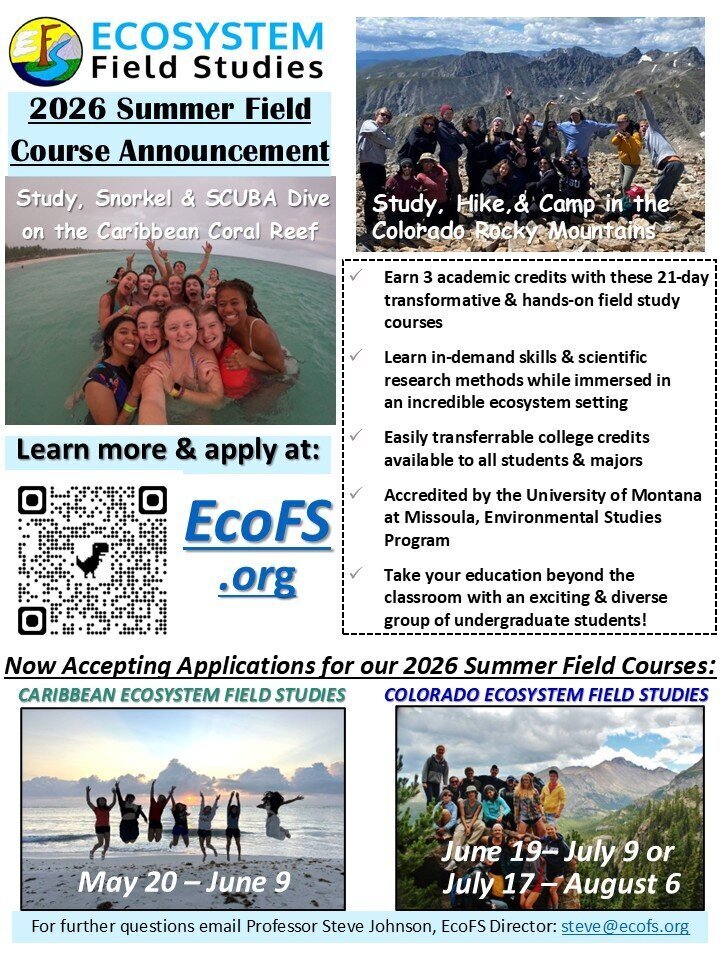
Summer field courses announcement!!!🌈🌍
| |||||||||||||||||||||||||||
|



Friday, January 23, 2026

Monday, November 10, 2025

Sunday, October 6, 2024
DANTA Tropical Biology and Conservation Field Courses in Costa Rica
We are pleased to announce our 2025 field courses in tropical biology. Our courses are intended for undergraduates or early graduate level students who have a keen interest in tropical ecosystems and conservation but have little or no experience of working in a tropical environment. Participants may enroll on either a credit or non-credit basis.
As much of our advertising is done by word-of-mouth, we encourage you to spread the word by forwarding this information to students or friends who may be interested in our programs.
For more information, please visit our website at www.danta.info and/or email conservation@danta.email. For an alumni perspective on our programs, please see our blog DANTAisms - http://dantablog.wordpress.com/ [dantablog.wordpress.com].
Tropical Biology and Conservation
Date: December 26- January 4, 2025
Program Fee: $1900
Application deadline: November 15, 2024
Methods in Primate Behavior and Conservation
Date: June 10-25, 2025
Program fee: $2900
Application deadline: May 1, 2025
Wildlife Conservation and Sustainability
Date: July 1-16, 2025
Program Fee: $2900
Application deadline: June 1, 2025
Field Excursion
All courses include a visit to a wildlife rehabilitation center, sustainable chocolate plantation and dolphin and snorkeling trip of the Golfo Dulce. We will stay overnight on the Boruca Indigenous Reserve where we will learn about the community and their traditional lifeways, and help with needed projects. Every effort is made to implement eco-friendly and socially responsible practices into our day-to-day operations, field courses and overall mission.
Tuesday, September 3, 2024
Learn at your own pace!
KULeuvenX: Global Challenges for a Sustainable Society
Our society today is facing many challenges: climate change, hunger, inequality,…
Although you probably have heard about or even personally experienced many of them, the information we get about these issues is often fragmented, incomplete, biased or even completely wrong.
Our team of experts will introduce you to different global challenges we face today and how they are linked to one another. This course will give you a good basic understanding of each of the challenges, their interrelationships and where we may look for possible solutions.
On top of an update of your knowledge on these challenges, you will learn to understand the data, see the bigger picture, and formulate knowledge-based arguments.
https://www.edx.org/learn/science/ku-leuven-global-challenges-for-a-sustainable-society
Monday, August 5, 2024
Fall Course Option - Molecular Pathogen Diagnostic Testing

There are no hard prerequisites for the course, other than having completed an introductory biology course covering molecular biology (e.g., BIOS 208), and ideally, a gateway course like BIOS 302. They are really looking for serious students who would like to get lab experience.
Course Description
This course is designed to provide students with foundational and technical skills required to work in a testing or research laboratory setting as a technician, using pathogen detection (and our wastewater surveillance testing lab) as an exemplar of the application of these skills. For natural science majors in the biology/chemistry fields, such positions are frequently the first jobs students enter after graduation, and often serve as a gateway to professional careers in STEM fields. Students will learn lab skills and foundational molecular biology techniques, building up to molecular diagnostic techniques via Reverse Transcription - quantitative PCR (RT-qPCR), the technical workflow we use in wastewater surveillance testing.
The course is a combination of background principles, which will be literature and information based, and lab skills, which will be executed and practiced in the lab. Each week, background material will be posted on the course Blackboard website and needs to be completed before coming to the lab on Fridays. Quizzes will be utilized to assess learning outcomes in each of the modules, and skills assessment will be used to gauge technical proficiency. The didactic (content) portion will be through Blackboard; the lab skills portion will be in-place. Thus, this laboratory course can be considered as “hybrid”.
What will I learn in this course?
- Lab Safety
- Solution preparation skills
- Basic micropipetting skills
- Aseptic technique and BSL-2 maintenance
- Automated and manual biologic concentration for downstream analysis
- Automated and manual nucleic acid extraction and isolation
- Polymerase Chain Reaction (PCR, incl. RT-qPCR)
- The basics of other pathogen detection modalities like rapid tests and ELISAs
- Construction of workflows and assay trouble-shooting
- Operation of common laboratory equipment
- The principles and components of experimental lab research and design, including variables, appropriate controls, standards, quantitative analysis, and maintenance of a laboratory notebook (record-keeping and organization)
ABOUT THE INSTRUCTOR
Dr. Barrie Bode grew up in a diverse working class neighborhood in Ferguson, MO (a near-north suburb of St Louis), went to public schools, and worked summer jobs (landscaping, restaurants, gas stations, life guard, construction) since age 14. He majored in Biology at Saint Louis University, and his first job after graduation was as a laboratory technician in an industrial lab, which he worked for two years while taking night courses in biochemistry. He went to graduate school and as a young parent earned his PhD in Biochemistry and Molecular Biology at the University of Florida College of Medicine. He did his postdoctoral research in the Liver Biology labs in the Health Sciences Division of Monsanto back in his hometown of St. Louis. From there, was recruited to Massachusetts General Hospital/Harvard Medical School in Boston to help establish and run the Surgical Oncology Research Laboratories, launched his academic career into the molecular physiological underpinnings of liver cancer – and taught surgical residents the principles and techniques of translational biomedical research. In 1999, he returned to Saint Louis University where he ran his NIH-funded lab in amino acid transport and cancer, taught multiple courses in molecular and cellular biology and human physiology, and was a member of the SLU Liver Center and Cancer Center in the Saint Louis University Medical Center. In 2009, he came to NIU as the new department chair of Biological Sciences – and held that position until the fall of 2020, when he was appointed to run the COVID-19 testing program on campus during the pandemic. In January of 2021, he established the wastewater surveillance testing program in collaboration with the Kishwaukee Water Reclamation District, and recruited Syed Hyder to help launch and run the wastewater testing laboratory. The program has been running for three years, and the evolving dashboard reporting virus levels has been in place since the spring of 2021. Beginning in the summer of 2023, Dr. Bode was appointed as the interim Associate VP for Research to help run the research enterprise on the NIU campus under new VPR, Dr. Yvonne Harris – also an NIU alumnus.
ABOUT THE COURSE
This lab course was made possible through a grant from SHIELD Illinois, who ran the saliva based SARS-CoV-2 rapid qPCR testing program in the state – including the NIU campus – during the pandemic. Molecular testing training is very expensive, so an external grant was required to create this course.
Back-story: As SHIELD-Illinois staffed their testing labs, it quickly became evident that there were not enough trained laboratory personnel to keep pace, and there was a need to look at workforce development beyond the COVID-19 pandemic. Likewise, our mission at NIU is to teach and train students for careers beyond academics. This course was therefore borne out of an intersection between mission and regional workforce needs. SHIELD Illinois likewise converted their testing labs in Chicago to partially engage in workforce development – led by NIU (and Bode lab) alumnus Natalie Lubbers – via the creation of the Clinical Laboratory Development Program (CLDP). The CLDP, based at the University of Illinois-Chicago (UIC) incubator space, is a more comprehensive program than this course, but the two closely align – and we work with the CLDP to inform curricular development. This course is the first iteration of this funded collaboration between the University of Illinois and NIU.
Monday, May 13, 2024
PSPA 302X - Government in Metropolitan Areas (Fall 2024)

There are two sections; P001 is regular and P002 is Honors.
Wednesday, April 10, 2024

Monday, March 25, 2024
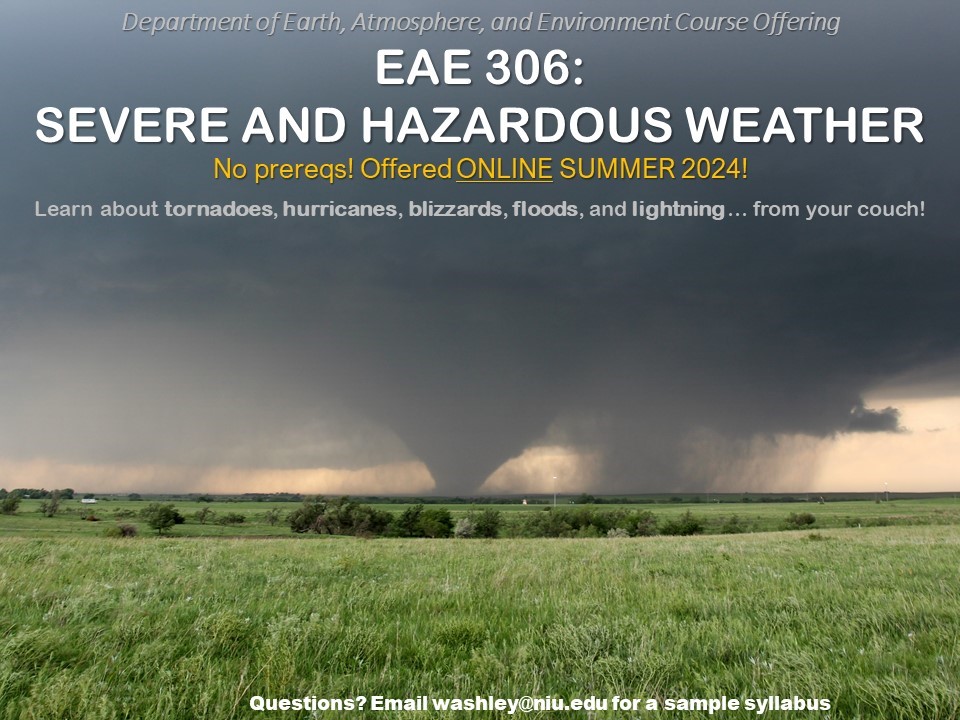
Online Summer Course No Prereqs!
GEOG 303: Water Resources & the Environment—FULLY ONLINE COURSE

Evaluation of water as a resource; its availability, distribution, use, and quality. Operation of the hydrologic cycle and relationships between surface water and the soil, groundwater, and atmosphere. Human impacts on water resources and the management of water-related hazards, including flooding, drought, and the spread of disease. Please email Dr. Sharon Ashley (sashley@niu.edu) if you have any questions or would like to see a sample syllabus.
GEOG 306: Severe & Hazardous Weather—FULLY ONLINE COURSE

Examination of fundamentals of atmospheric phenomena with an emphasis on understanding concepts and processes behind severe manifestations of weather and climate. Physical aspects of extratropical cyclones, winter weather phenomena, thunderstorm phenomena, tropical weather systems, and large-scale, longer-term weather events are analyzed. Case studies are employed to investigate human, economic, and environmental consequences of extreme weather and climate events. Please email Dr. Walker Ashley (washley@niu.edu) if you have any questions or would like to see a sample syllabus.
Wednesday, November 29, 2023
Course for ENVS Students!!!
PHIL 360 offers an introductory overview of philosophical issues in science: What is science? In what ways can scientific beliefs be explained by social phenomena? Why do we, or should we, prefer some scientific theories to others? The course does not require any background in science or philosophy.

Thursday, November 9, 2023
TECH 245 (Non lecture based course)
TECH 245: Pollution, Prevention and Sustainable Production (a
GenEd course)
Spring 2024. T/Th 11-12:15. Still Gym 211
Instructor. Dr. Theodore J. Hogan
Knowledge Domain: Sustainability Pathway
You
will learn about sustainability
- It's
complicated
- Simple
solutions like buying "green" won't work
- The whole supply chain (from
mineral extraction to your hands) contributes to the environmental impacts
of a product
How
you will learn?
- Active
learning. Not lectures
- By
taking apart a phone accessory (and its packaging) and looking at the
lifecycle of each component (plastics, paper, and metals)
- By
redesigning the phone accessory and manufacturing process to reduce
overall life cycle impacts
- By
examining how sustainability can be good for businesses
Field Courses for 2024!
Danta is pleased to
announce our 2024 field courses in tropical biology. Our courses are intended
for undergraduates or early graduate level students who have a keen interest in
tropical ecosystems and conservation but have little or no experience of working
in a tropical environment. Participants may enroll on either a credit or
non-credit basis.
As much of our advertising is done by word-of-mouth, we encourage you to spread
the word by forwarding this information to students or friends who may be
interested in our programs.
For more information, please visit our website at www.danta.info and/or
email conservation@danta.email. For an alumni
perspective on our programs, please see our blog DANTAisms - http://dantablog.wordpress.com/
[dantablog.wordpress.com].
Conservation and Sustainability in Costa Rica
Winter Session: December
27 – January 10, 2024, Application Deadline: December 1, 2023
Summer Session: June 5 -20, 2024;
Application Deadline: May 1, 2024
Program Fee: $2900
Application deadline: May 15, 2023
Course Description: DANTA
Blog
Methods in Primate Behavior and Conservation
Date: July 11 - 26, 2024
Program fee: $2900
Application deadline: May 1, 2024
Course Description: DANTA
Blog
Field Excursion
All courses include a visit to a wildlife rehabilitation center, sustainable
chocolate plantation and dolphin and snorkeling trip of the Golfo Dulce. We
will stay overnight on the Boruca Indigenous Reserve where we will learn about
the community and their traditional lifeways, and help with needed projects.
Every effort is made to implement eco-friendly and socially responsible
practices into our day-to-day operations, field courses and overall mission.
Subscribe to:
Posts (Atom)